
3M says its Scratch Removal System is designed to remove minor scratches, scuffs, and small defects from automotive clear coats using sanding, compounding, and polishing (3M, search snippet and product documentation, accessed 2026). That gives us the first honest answer: some scratches can be removed at home, but only minor ones.
If the scratch is deep, through the clear coat, or exposing colour or primer, no miracle bottle is going to fix it safely. But for light marks, scuffs, and clear-coat scratches, a careful DIY process can work surprisingly well.
This guide is written for Indian car owners dealing with real-world problems: parking scratches, bike-handle marks, hard-water haze around a scuff, and minor door scrapes you just want gone without making things worse.
TL;DR: You can remove many light car scratches at home if they are only in the clear coat. 3M specifically markets a scratch system for minor scratches and scuffs on automotive clear coats, while PPG says OEM paint is only about 90–120 microns thick, so deep scratches should be handled carefully or professionally (3M; PPG).
Before You Begin
PPG places OEM paint thickness at about 90–120 microns total (PPG Refinish, accessed 2026). That means your car’s paint does not have endless room for experimentation.
What you’ll need:
– pH-safe car shampoo
– microfiber towels
– scratch remover or compound for clear-coat defects
– applicator pad or dual-action polisher
– optional clay bar if surface is contaminated
– touch-up paint only if the scratch is deeper
– strong light or sunlight for inspection
Time: 30 minutes to 2 hours
Difficulty: Beginner to intermediate
Best conditions: Shade, cool panel, clean workspace
Step 1: Identify the Type of Scratch
3M’s scratch-removal products target minor scratches and small defects on clear coats, which means the first step is classification, not rubbing product everywhere (3M, accessed 2026). By the end of this step, you’ll know whether the scratch is DIY-friendly.
The easiest home test
- Wash the area.
- Dry it.
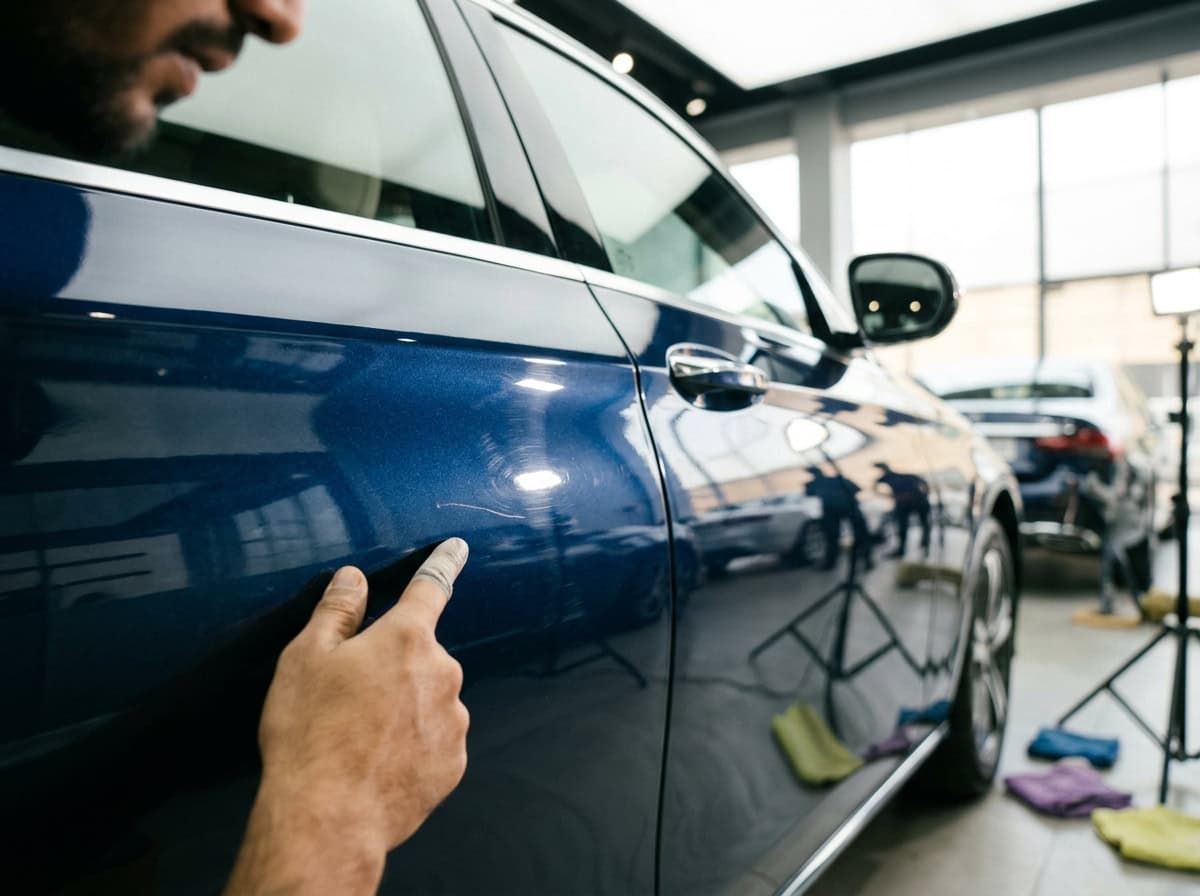
- Run a clean fingernail lightly across the scratch.
What the result usually means
- Doesn’t catch much: likely light clear-coat scratch or scuff.
- Catches slightly: may still improve with correction.
- Catches hard / shows colour loss: likely too deep for simple DIY removal.
- Shows white paint transfer: may be a scuff, not a true scratch.
Types of car scratches
Clear-coat scratch: best DIY candidate.
Base-coat scratch: may need touch-up or repaint.
Primer-level damage: not a polishing job.
Paint transfer/scuff: often removable with surprisingly mild methods.
Verification: If the damage appears shallow and still glossy around the edges, continue. If primer or metal is visible, stop.
Step 2: Wash and Clean the Area Properly
India’s car-care market hit USD 424.92 million in 2024, partly because more owners are moving toward better maintenance routines and products (IMARC Group, 2025). That matters because scratch repair on a dirty panel creates fresh damage.
By the end of this step, the area will be ready for safe inspection and correction.
What to do
- Wash the panel with car shampoo.
- Dry it with a clean microfiber towel.
- If the surface feels rough, clay it lightly.
- Reinspect the mark in direct light.
Sometimes the “scratch” you panicked about is only paint transfer, tar, or surface contamination. Lovely when that happens.
Verification: The mark should now be clearly visible in its true form, without dirt hiding or exaggerating it.
Step 3: Start with the Least Aggressive Method First
Meguiar’s says its Ultimate Compound is safe and effective on clear coat and can be used by hand or DA polisher (Meguiar’s, accessed 2026). That gives us the smartest rule in DIY scratch work: always begin with the mildest method that has a chance of success.
By the end of this step, you’ll know whether a light hand correction is enough.
Try this first
- Apply a small amount of scratch remover or mild compound to an applicator.
- Work only on the affected spot.
- Use moderate pressure in short, overlapping motions.
- Wipe clean.
- Inspect before repeating.
If the scratch improves noticeably after one or two attempts, you’re probably in clear-coat territory. If nothing changes, don’t keep grinding away mindlessly.
Verification: Look for reduced visibility, smoother reflection, and no fresh haze.
Citation capsule: The safest DIY approach to car scratches is to begin with the least aggressive clear-coat-safe product and reassess after a small test spot. Meguiar’s clear-coat-safe compound guidance and PPG’s thin OEM paint figures support the same principle: home correction should be conservative because the goal is improvement, not reckless material removal (Meguiar’s; PPG).

Step 4: Use Machine Correction Only If Needed
3M’s scratch-removal systems and rubbing compounds exist because some defects need more than hand pressure (3M, accessed 2026). By the end of this step, you’ll know when a car rubbing machine or DA polisher makes sense.
Use a dual-action polisher when
- the scratch is still light but stubborn,
- you have the right pad and product,
- you can keep the pad flat,
- and you’re avoiding sharp edges.
Basic DA process
- Prime the pad lightly.
- Spread product before increasing speed.
- Work a very small area.
- Use slow overlapping passes.
- Wipe and inspect.
A dual-action machine is usually safer for beginners than a rotary. If that sentence saves you from buying the wrong machine, I’ve done my job.
Verification: The area should improve without severe haze, pad trails, or heat build-up.
Step 5: Know When a Scratch Needs Touch-Up, Not Polishing
PPG’s film-build guidance is the reality check here: with only 90–120 microns of OEM paint overall, deeper defects cannot be polished away indefinitely (PPG, accessed 2026). By the end of this step, you’ll know when to stop trying to “remove” the scratch and move to repair instead.
Use touch-up or pro repair when
- primer or metal is visible,
- the scratch catches your nail strongly,
- the panel edge is involved,
- the damage is wide and deep,
- there is paint chipping.
For these cases, your real goal changes from removal to making the damage less visible and protecting the exposed area.
Important mindset shift: Deep scratches are often improved, not erased. Chasing total removal can cause more harm than the scratch itself.
Citation capsule: Not every scratch should be polished. PPG’s paint-thickness guidance makes that clear: when total OEM film build is only about 90–120 microns, scratches that cut deeply into the paint system are better handled with touch-up, repaint work, or professional correction rather than aggressive DIY compounding (PPG).
Step 6: Refine and Protect the Area After Correction
3M notes that compounds can leave a high-gloss finish while reducing surface defects, but correction alone is not the end of the job (3M, accessed 2026). By the end of this step, the area should look cleaner and be protected from fresh contamination.
What to do next
- Wipe off all residue.
- If needed, follow with a finer polish.
- Apply wax, sealant, or coating topper.
- Avoid dirty washing for the next few days.
That protection step matters because freshly corrected paint can pick up defects again very quickly if you go straight back to rough washing.
Common Mistakes to Avoid
3M’s scratch-removal messaging focuses on minor scratches for a reason (3M, accessed 2026). Most DIY problems start when people ignore that word.
1. Treating every scratch as removable
Some need touch-up or repainting, not more rubbing.
2. Working on a dirty panel
Dust and grit can create additional scratches.
3. Using too much pressure too early
Start mild. Escalate only if the defect responds.
4. Polishing edges aggressively
Edges and raised contours are risk zones.
5. Expecting miracles from one product
Compound, polish, touch-up, and protection all have different jobs.
The saddest DIY fail: a light scratch that could have been improved nicely, made worse because someone kept rubbing long after the paint stopped responding.
Results: What Success Looks Like
A successful home scratch repair does not always mean the mark vanishes. It means the defect is reduced safely, reflections look cleaner, and the area no longer jumps out at you every time you see the car.
For Indian daily drivers, that’s a great result. Perfection is lovely. Sensible improvement is smarter.
Frequently Asked Questions
Can toothpaste remove car scratches at home?
Sometimes it can improve very light scuffs because it has mild abrasives, but it is not a proper detailing product. On modern thin clear coats, using a purpose-made scratch remover or clear-coat-safe compound is the smarter and more predictable option.
How do I know if a scratch is too deep to remove?
If your fingernail catches strongly, or if you can see base colour change, primer, or metal, it is usually too deep for safe removal by polishing alone. At that point, touch-up or professional repair is the better route.
Can I remove car scratches by hand without a machine?
Yes, many light clear-coat scratches and scuffs can be improved by hand. Meguiar’s notes that clear-coat-safe compound can be applied by hand or by DA machine, which makes small-area DIY correction realistic (Meguiar’s).
What are the main types of car scratches?
The useful categories are clear-coat scratches, base-coat scratches, primer-level damage, and paint transfer or scuffs. Clear-coat scratches are the most DIY-friendly, while deeper categories often need touch-up or repaint work instead of compounding.
Should I apply wax or ceramic protection after scratch removal?
Yes. After correction, the paint should be protected. Wax or sealant is fine for a simple DIY job, while ceramic protection makes more sense if you want longer-lasting maintenance benefits and the rest of the paint is in good condition.