
Car detailing means cleaning, correcting, and protecting a vehicle far more thoroughly than a normal wash. That matters because Indian owners are spending more on appearance and long-term care: Grand View Research says the India car detailing services market generated USD 3,633.4 million in 2024 and is forecast to grow at a 6.4% CAGR from 2025 to 2030 (Grand View Research, 2025).
If you own a hatchback, SUV, superbike, or weekend motorcycle, detailing is how you preserve gloss, cabin hygiene, and resale value. In this guide, you’ll learn what car detailing really means, the main types, the usual step-by-step process, and when it makes sense to book a pro instead of trying a home wash.
TL;DR: Car detailing is a deep clean plus surface correction and protection, not just soap and water. India’s detailing market reached USD 3,633.4 million in 2024 according to Grand View Research, which reflects rising demand for better paint, interior, and coating care among car and bike owners.
Table of Contents
- What does car detailing actually mean?
- Why does detailing matter in India?
- What are the main types of car detailing?
- What is the usual car detailing process?
- What does a detailing package usually include?
- Should you detail at home or hire a pro?
- How often should you detail your car or bike?
- Conclusion
What does car detailing actually mean?
India’s detailing business keeps growing because owners increasingly want more than a quick wash; Grand View Research says the country’s detailing market reached USD 3.63 billion in 2024 (Grand View Research, 2025). In simple words, car detailing means restoring a vehicle’s appearance through careful cleaning, decontamination, correction, and protection.
A normal car wash removes loose dirt. Detailing goes several steps further. It targets paint contamination, swirl marks, hard-water spots, stained interiors, faded trims, cloudy glass, and neglected wheels. On a bike, detailing also means careful work around exposed metal, painted fairings, plastics, and chain-area grime.
Gtechniq describes modern ceramic protection as a chemically bonding layer that helps repel water, dirt, UV exposure, bird droppings, and other contamination (Gtechniq, 2025). That’s why detailing is best understood as a system, not a single service.
The simplest definition
Car detailing is the process of deep cleaning, improving, and protecting a vehicle’s interior and exterior so it looks better and stays easier to maintain.
What detailing is not
- It is not just foam and rinse.
- It is not the same as repainting.
- It is not a magic way to make paint scratch-proof.
- It is not always expensive if you choose the right level of service.
In India, many owners say “detailing” when they really mean “full cleaning.” The real difference is whether the job includes paint inspection, contamination removal, and protection. If those steps are missing, you probably bought a premium wash, not a detail.
According to Nexdigm, the India car detailing market is valued at INR 3,200 crore, and the report says over 18 million detailing jobs were recorded in the previous year (Nexdigm, 2025). That scale explains why the term gets used loosely. A proper detail should still be process-led.
Why does detailing matter in India?
Detailing matters in India because heat, UV, dust, hard water, traffic film, and monsoon grime age a car faster than many owners expect. Grand View Research says India’s detailing market is expected to grow at 6.4% CAGR from 2025 to 2030 (Grand View Research, 2025), which suggests owners increasingly see vehicle care as protection, not vanity.
Think about a typical Indian ownership pattern. The car sits outdoors at work. It gets splashed in traffic. It picks up cement dust from construction, bird droppings, and borewell water marks from apartment washes. Bikes have it even tougher. They live in open parking, face chain grease, monsoon sludge, and heat cycling almost daily.
Nexdigm notes that cities like Delhi NCR, Bengaluru, Mumbai, and Hyderabad lead demand for detailing, helped by higher vehicle density and stronger awareness of coatings and surface care (Nexdigm, 2025). That lines up with what owners already feel: daily use leaves visible wear fast.
A good detail helps in four practical ways:
- It reduces bonded contamination before it etches paint.
- It restores gloss by reducing haze and swirl marks.
- It protects paint, trim, leather, or plastics with the right products.
- It makes routine washing easier afterward.
This is also why resale-minded owners care. A five-year-old car that still looks crisp inside and out feels “maintained,” not “used.” That perception matters when a buyer walks around the vehicle. Isn’t that exactly what most owners want?
According to 3M India, ceramic coating is positioned as a professionally applied treatment that creates a slick surface for easier maintenance and can remain durable for up to five years with proper care (3M India, 2026). Whether or not you choose ceramic, the point is clear: detailing is about making upkeep easier later.
What are the main types of car detailing?
Exterior detailing remains the biggest service segment in India, while interior detailing is forecast as the fastest-growing segment, according to Grand View Research (Grand View Research, 2025). In practice, most detail jobs fall into a few clear categories.
1. Exterior detailing
This covers wash, decontamination, polishing, glass cleaning, trim dressing, tyre dressing, and paint protection. It is the most visible kind of detailing. If someone says, “My car came back glossy,” this is usually what they bought.
2. Interior detailing
This includes vacuuming, shampooing, steam cleaning where appropriate, leather cleaning, fabric care, dashboard and door-panel treatment, and odour control. Grand View Research says interior detailing is the fastest-growing type segment in India (Grand View Research, 2025), which makes sense as people now care more about cabin hygiene and comfort.
3. Paint correction
This is the defect-removal stage. It uses polish and machine polishing to reduce swirl marks, oxidation, haze, and some scratches. Correction is what turns “clean paint” into “sharp paint.”
4. Protective detailing
This includes wax, sealant, spray coating, ceramic coating, graphene-labeled coatings, glass treatment, wheel coating, and trim protection. Gtechniq says consumer-grade ceramic coatings generally protect for 1 to 3 years, while some pro-grade options can carry guarantees up to 9 years (Gtechniq, 2025).
5. Bike detailing
Bike detailing focuses on painted panels, tank, plastics, chrome, alloy wheels, seats, and exposed areas that trap chain fling and road grime. The steps are similar to car detailing, but the tools and care level differ because bikes have tighter gaps and more exposed parts.
According to Nexdigm, ceramic coating is already one of the leading service sub-segments in India’s detailing market (Nexdigm, 2025). That’s why many studios now bundle protection into even “mid-level” packages.
What is the usual car detailing process?
A proper detail follows an ordered process, not random product use. Gtechniq says ceramic coating success depends on surface preparation, including washing, decontamination, and oil removal before protection (Gtechniq, 2025). That’s also true for non-coating details.
Here’s the usual workflow in plain English.
1. Inspection
The detailer checks paint condition, swirl levels, stains, chips, plastic fading, and water spotting. This is where package selection should happen.
2. Pre-wash and wash
Loose dirt is rinsed off. Wheels are cleaned separately. The body is then washed safely using proper lubrication.
3. Decontamination
Iron fallout, tar, tree sap, and bonded grime are removed using chemical decontamination and sometimes clay treatment.
4. Drying and paint assessment
The vehicle is dried carefully so marks are not added during the process.
5. Paint correction, if needed
Light polishing, one-step correction, or multi-stage correction is done depending on the defect level.
6. Surface prep
Polishing oils or old protection are removed so wax, sealant, or ceramic can bond correctly.
7. Protection stage
This may be wax, sealant, spray coating, ceramic coating, or surface-specific dressing.
8. Interior and finishing work
Cabin cleaning, glass finishing, trim dressing, and final checks complete the job.
The Rag Company’s 2026 ceramic coating guide follows exactly this logic: wheel and tyre cleaning first, then wash, decontamination, paint correction, panel wipe, coating application, and aftercare (The Rag Company, 2026). Good detailing is basically disciplined sequencing.
A common Indian-owner mistake is judging the job by foam alone. Foam looks dramatic, but the real quality shows up later: fewer wash marring marks, cleaner door jambs, smoother paint, and a cabin that still feels fresh after a week.
According to Gtechniq, ceramic coatings are not completely scratch-proof, but they do add light scratch resistance and easier cleaning (Gtechniq, 2025). That’s why prep matters more than any flashy bottle label.
What does a detailing package usually include?
Market demand in India keeps broadening, and Nexdigm says ceramic coating, exterior detailing, interior detailing, and complete packages are now distinct service categories (Nexdigm, 2025). So what should you expect when you compare packages?
Basic detail
- Wash and dry
- Wheel cleaning
- Vacuuming
- Dashboard wipe-down
- Tyre dressing
- Glass cleaning
Mid-level detail
- Everything in basic
- Chemical decontamination
- Machine polish or gloss enhancement
- Upholstery or leather treatment
- Spray sealant or short-term protection
Full detail
- Full exterior decontamination
- Paint correction
- Interior deep clean
- Engine bay cleaning, where safe
- Long-term protection such as sealant or ceramic
Ceramic package
- Deep prep wash
- Iron/tar removal
- Clay or synthetic decontamination
- Paint correction if required
- Panel wipe
- Ceramic coating application
- Cure guidance and maintenance instructions
According to 3M India, one of the selling points of ceramic coating is easier maintenance later because of its slick surface and strong water beading (3M India, 2026). That’s useful, but only if the package includes real prep work first.
Should you detail at home or hire a pro?
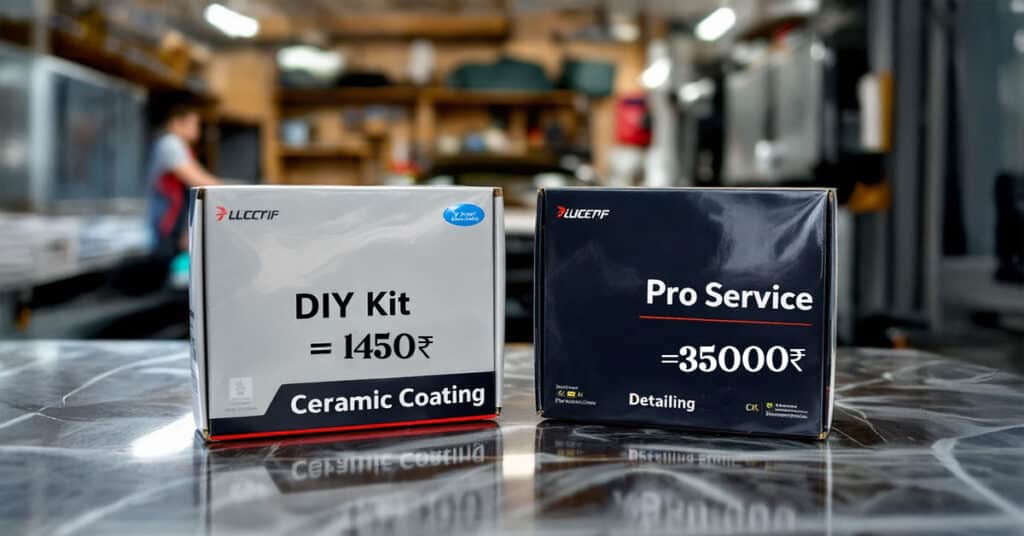
Professional-grade coatings can carry guarantees of up to 9 years, while DIY consumer products more commonly sit in the 1–3 year range, according to Gtechniq (Gtechniq, 2025). So the right answer depends on the job, your space, and your patience.
DIY makes sense when:
- You want regular maintenance washes.
- You are applying a spray sealant or beginner-friendly product.
- Your paint is already in decent condition.
- You have shade, time, and proper microfiber tools.
Hire a pro when:
- The car has swirl marks, water spots, or oxidation.
- You want machine polishing or paint correction.
- You are paying for ceramic coating.
- Your vehicle is new and you want the best starting point.
- You own a dark car that shows every mistake.
Autoglym’s ceramic coating instructions recommend working in 50 cm x 50 cm sections, watching flash times carefully, allowing at least 4 hours of cure time, and avoiding washing for 24 hours after application (Autoglym, 2026). That tells you something important: coating work is manageable, but not casual.
For most Indian owners, the smartest split is this: do safe maintenance washing at home, but outsource correction and long-term coating work. That gives you better value than trying to become a full-time detailer on your apartment parking ramp.
How often should you detail your car or bike?
Regular maintenance strongly affects protection life. Gtechniq says ceramic coatings can last 2 to 10 years depending on product quality, application quality, and aftercare (Gtechniq, 2025). That means detailing frequency depends on use, parking, and what protection is already on the vehicle.
A practical Indian schedule looks like this:
- Weekly or fortnightly: safe wash for daily-driven cars and bikes
- Every 2–3 months: decontamination check, trim care, glass reset
- Every 6–12 months: gloss enhancement or protection top-up
- As needed: stain removal, odour treatment, paint correction
If your vehicle sits outdoors, lives in a coastal area, or gets hard-water washes, shorten the interval. If it stays covered and is washed correctly, you can stretch it.
According to Chemical Guys, over 95% of swirls and scratches come from improper washing methods, poor towels, single-bucket washing, and bad drying habits (Chemical Guys, 2025). So frequency matters, but technique matters more.
Frequently Asked Questions
Is car detailing the same as car washing?
No. Car washing removes surface dirt, while detailing includes deeper cleaning, correction, and protection. That’s why the category is growing so quickly in India; Grand View Research says the country’s detailing market reached USD 3,633.4 million in 2024 (Grand View Research, 2025).
Does detailing remove scratches?
Detailing can reduce or remove many light scratches and swirl marks through paint correction, but it will not fix deep paint damage without repainting. Gtechniq also notes ceramic coatings are scratch-resistant, not scratch-proof (Gtechniq, 2025).
Is car detailing worth it for older cars?
Yes, often more than people expect. Older cars usually benefit from interior restoration, stain removal, and gloss recovery. Nexdigm says India recorded over 18 million detailing jobs in the previous year (Nexdigm, 2025), which shows demand is not limited to new cars.
Can bike owners also benefit from detailing?
Absolutely. Bikes face more exposed contamination than cars, especially in monsoon riding and dusty city traffic. Gtechniq even markets dedicated bike coatings with hydrophobic and grime-resistant benefits (Gtechniq, 2025).
How long does a full detail usually last?
The visible result depends on use and maintenance. A basic detail may feel fresh for weeks, while ceramic-backed protection can last far longer; Gtechniq says coating lifespan can range from 2 to 10 years depending on product, prep, and aftercare (Gtechniq, 2025).
Conclusion: What car detailing really means for Indian owners
Car detailing means giving your vehicle the kind of care a regular wash simply can’t deliver. It combines deep cleaning, cosmetic improvement, and protection in one structured process. In Indian conditions, that matters more than ever.
The smart takeaway is simple:
- A wash cleans the surface.
- A detail restores the surface.
- Protection helps preserve that result.
If your car or bike faces heat, dust, hard water, or rough daily use, detailing is not overkill. It is preventive maintenance with visual benefits.
Continue Learning
Fundamentals:
How-To Guides:
–
–
Advanced:
–
–