How Long Does Ceramic Coating Last? (Realistic Expectations)
How long does ceramic coating last in real life? Gtechniq says lifespan can range from 2 to 10 years, depending on product quality, prep, and aftercare.
How long a ceramic coating lasts depends far more on how you treat it than on the brand on the bottle. Gtechniq puts the range at 2 to 10 years, with product quality, application, and aftercare deciding where you land (Gtechniq, 2025). That spread is why Indian owners hear such different answers.
Here’s the realistic version, not the sales version. If you park outside, wash with hard water, skip maintenance, or drive through dust and monsoon grime every day, your coating won’t live as long as a weekend car in covered parking.
TL;DR: Ceramic coating lasts roughly 2 to 10 years (Gtechniq), but real durability comes down to prep, installer skill, weather, and washing habits. For most Indian daily drivers, plan for the lifespan you can maintain, not the brochure maximum.
This page covers the most common questions in four categories:
Getting started — what lifespan claims really mean
How it works — why some coatings fail early
Common problems — what shortens durability
Advanced questions — how to stretch coating life sensibly
Gtechniq puts the typical range at 2 to 10 years when a coating is applied correctly and maintained (Gtechniq, 2025). Short-life coatings tend to be consumer-grade or poorly looked after. Long-life ones are usually professional systems with better prep and steady aftercare. A rough guide:
Spray or light DIY coatings: months to about a year
Stronger DIY coatings: 1 to 3 years
Professional coatings: several years
Why does one brand say 5 years and another say 9?
Because they’re describing different product tiers, installer requirements, and maintenance standards. Consumer-grade coatings generally give 1 to 3 years; some professional systems carry guarantees up to 9 years (Gtechniq, 2025). Both can be true. They’re just different products with different assumptions.
Is the claimed lifespan the same as real-world lifespan?
Rarely. The claim is the maximum under ideal conditions. What you actually get reflects your parking, climate, wash routine, and water quality. If your car sits outside all summer, gets borewell washes, and rarely gets decontaminated, the coating may still be there chemically while performing nothing like you expected.
How coating life actually works
What makes a coating last longer?
Three things: proper prep, correct application, and good maintenance. Gtechniq notes that poor application cuts durability, while regular washing preserves the water-beading (Gtechniq, 2025). The Rag Company’s process runs wash, decontamination, paint correction, panel wipe, then application, which shows longevity starts well before the bottle is even open (The Rag Company, 2026).
Does it stop wearing out if the car is parked inside?
No, but indoor parking slows the wear. UV, harsh chemicals, scratches, and heat all shorten coating life, and covered parking takes the edge off the heat and UV especially. For Indian owners that’s a real split: a garage-kept second car holds its coating far longer than a daily commuter parked outside at home and office.
Is water beading the same as coating life?
Not exactly. Weaker beading often means the surface is clogged, dirty, or sitting under topper residue, not that the coating is dead. Performance also includes easier cleaning, chemical resistance, and gloss. In practice, “my coating is gone” usually means the surface needs a proper wash and decontamination, not a recoat.
What shortens coating life
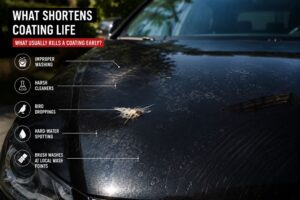
What usually kills a coating early?
Gtechniq’s list is long: poor maintenance, harsh chemicals, UV, scratches, heat, bad application, and contamination during curing (Gtechniq, 2025). But most real-world failures come down to a few habits:
Improper washing
Harsh cleaners
Letting bird droppings sit too long
Hard-water spotting
Brush washes at local wash points
Most swirls and scratches trace back to bad wash technique and tools (Chemical Guys, 2025), and every careless wash chips away at the finish.
Does Indian weather shorten coating life?
It can. Heat, UV, monsoon contamination, dust, and mineral-heavy water all raise the maintenance burden, and Gtechniq lists sun, UV, and extreme temperatures among the things that speed up degradation. That doesn’t mean coatings fail fast in India. It means you have to maintain them more deliberately than the brochures suggest.
Do harsh shampoos or local detergents damage coatings?
They can. Gtechniq warns that harsh chemicals and some wash products strip the protective layer and shorten life. A pH-balanced shampoo and gentle wash media, used in the shade, are the safer default (Chemical Guys, 2025).
Stretching coating life
Do maintenance toppers help?
Often, yes. They keep the surface slick and water-repelling, especially after repeated washes. The Rag Company recommends pH-neutral washing plus a periodic ceramic sealant top-up (The Rag Company, 2026). A topper won’t revive a failed coating, but it preserves a healthy one.
Should you recoat the whole car when performance drops?
Not straight away. Wash properly, decontaminate, and inspect first. If the beading and slickness come back, you only needed maintenance. If the finish still feels flat and behaves inconsistently, then it’s time to polish and reapply.
Is “crystal coating” longer-lasting than ceramic?
Usually not as a category. “Crystal coating” is often a brand or sales label, not a separate chemistry. Gtechniq’s own Crystal Serum Light carries a 5-year guarantee applied professionally, and Crystal Serum Ultra a 9-year one through accredited detailers (Gtechniq, 2025). The word “crystal” alone guarantees nothing.
Related Resources
What is ceramic coating? — The basics of bonding, beading, and paint protection.
How to apply ceramic coating — Full prep and application walkthrough for DIY readers.
If your coating is beading less, don’t jump to polishing. Wash it properly, decontaminate it, and look closely first. A lot of “dead coating” cases are maintenance problems in disguise.
Frequently asked questions
How long does ceramic coating last on a daily-driven Indian car?
Usually less than the brochure maximum, because heat, dust, hard water, and outdoor parking all add stress. The overall range runs 2 to 10 years depending on prep and aftercare (Gtechniq, 2025).
Can a coating still work if water beading gets weaker?
Yes. Weak beading doesn’t always mean it’s gone. The surface may just be clogged with minerals or road film. A proper wash and decontamination often change the picture before any reapplication.
Does professional application really make a difference?
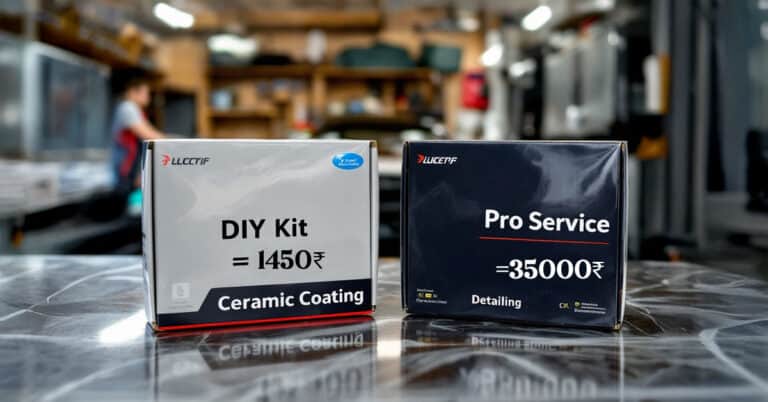
Usually. DIY coatings tend to last 1 to 3 years, while some accredited professional systems carry guarantees up to 9 years. Installer skill is often the gap between average and impressive longevity.
Can a coating last longer on a bike than on a car?
Often not, since bikes face more exposed contamination, tighter cleaning areas, and rougher use. A well-cared-for bike still gets easier cleaning and grime resistance, though.
Is ceramic coating worth redoing after a few years?
Yes, if you still want gloss, easy washing, and paint protection. Pro coatings stay durable for around five years with care, so renewing after a few years is normal, not a failure.
RN
About the author
Rahul Nambiyar
SCC Journal at Super Ceramic Coating. Writing field notes from the lab and the studio.