
3M says rubbing compound removes sand scratches, oxidation, water spots, and surface blemishes from clear coats (3M, accessed 2026). That’s the first thing to understand: rubbing polish is not just “shine cream.” It is an abrasive product used to cut defects and restore clarity.
Used correctly, it can rescue tired paint. Used carelessly, it can create haze, swirls, or worse, eat into already thin clear coat.
For Indian car owners, the topic matters because our cars collect oxidation, hard-water marks, monsoon grime, tree sap, and wash marring faster than we’d like. So let’s make this practical.
TL;DR: Rubbing polish is an abrasive correction product used to reduce defects like oxidation, light scratches, and water spots. 3M specifically lists those defects for compounding work. Use it only when normal washing or finishing polish is not enough, and always start with the least aggressive method first (3M, accessed 2026).
Before You Begin
PPG says OEM paint thickness is roughly 90–120 microns overall (PPG Refinish, accessed 2026). So before you rub anything into your paint, remember this: modern paint is thinner than it looks.
What you’ll need:
– pH-safe car shampoo
– microfiber wash mitt and drying towel
– clay bar or clay mitt if the surface is contaminated
– rubbing polish or compound
– foam or microfiber applicator pad
– optional dual-action machine polisher
– clean microfiber towels
– panel light or sunlight for inspection
Estimated time: 1–3 hours for spot work, longer for full-car work
Difficulty: Beginner by hand, intermediate with a machine
Best practice: Work in shade on cool paint only

Step 1: Identify Whether You Need Rubbing Polish at All
3M positions rubbing compound for defects like oxidation, water spots, and sanding scratches, which tells you it is a correction step, not a routine wash step (3M, accessed 2026). By the end of this step, you’ll know whether rubbing polish is necessary or whether a lighter product will do.
How to check
- Wash and dry the panel properly.
- Inspect under strong light.
- Run a clean fingertip lightly across the area.
- Ask: is this defect above the surface, in the paint, or too deep?
Use rubbing polish when
- oxidation is dulling the finish,
- light scratches and swirls are visible,
- water spots remain after washing,
- a basic finishing polish is too weak.
Do not use rubbing polish first when
- the issue is just loose dirt,
- the paint feels contaminated and needs claying first,
- the scratch catches a fingernail deeply,
- the panel has repainted edges you’re unsure about.
Verification: If the defect looks like it is in the upper clear-coat layer, rubbing polish may help. If it is deep, chipped, or through the paint, stop.
Step 2: Wash, Decontaminate, and Dry the Surface Properly
India’s car-care market reached USD 424.92 million in 2024, in part because buyers are moving toward better maintenance products and higher-end care routines (IMARC Group, 2025). That matters because polishing dirty paint is one of the fastest ways to make things worse.
By the end of this step, you’ll have a clean surface that won’t trap grit under your applicator or pad.
What to do
- Wash the car with a pH-safe shampoo.
- Dry it completely.
- Feel the paint with a clean hand inside a plastic bag.
- If it feels rough, clay the surface lightly.
- Wipe clean again.
If you skip decontamination, trapped particles can create fresh marring while you polish. That’s not correction. That’s self-sabotage.
Verification: The paint should feel smooth and look clean before you touch rubbing polish.
Common DIY mistake: People rub compound straight onto dusty paint because the car “looked clean enough.” It never is.
Step 3: Start with the Least Aggressive Method
Meguiar’s says its Ultimate Compound is safe on clear coat and single-stage paint and can be applied by hand or with a dual-action polisher (Meguiar’s, snippet via source page, accessed 2026). That gives us the right principle: start mild.
By the end of this step, you’ll test a small area before committing to a larger correction.
Test spot process
- Pick a small 1 ft x 1 ft area.
- Apply a little product to an applicator or pad.
- Work in slow, overlapping passes.
- Wipe residue clean.
- Inspect before repeating.
If hand application improves the defect enough, stop there. You do not win extra points for removing more clear coat than needed.
Verification: The test spot should show visible improvement without haze or fresh marks.
Citation capsule: Rubbing polish should always start with a test spot and the least aggressive method because automotive paint is thin. PPG places OEM film build at roughly 90–120 microns, while Meguiar’s positions compounds as clear-coat-safe when used properly. The safe lesson for DIY owners is simple: correct only as much as needed, not as much as possible (PPG; Meguiar’s).
Step 4: Apply Rubbing Polish by Hand or Machine
3M says rubbing compounds reduce compounding time and can remove defects quickly, but speed is exactly why technique matters (3M, accessed 2026). By the end of this step, you’ll know how to work the product safely.
By hand
- Use a foam or microfiber applicator.
- Work on a small section only.
- Apply moderate pressure, then lighten up as the product breaks down.
- Buff off with a clean microfiber.
By car rubbing machine / DA polisher
- Use a dual-action polisher, not a rotary, if you’re new.
- Prime the pad lightly.
- Spread product first, then increase speed gradually.
- Keep the pad flat.
- Do 3–4 slow, overlapping passes.
- Wipe and inspect.
A rotary machine cuts faster, but it also raises the risk of haze, holograms, or edge damage. For most Indian DIY users, a dual-action machine is the friendlier choice.
Verification: The panel should show cleaner reflections and reduced defects, not fresh haze or pad trails.
Step 5: Inspect, Refine, and Protect the Finish
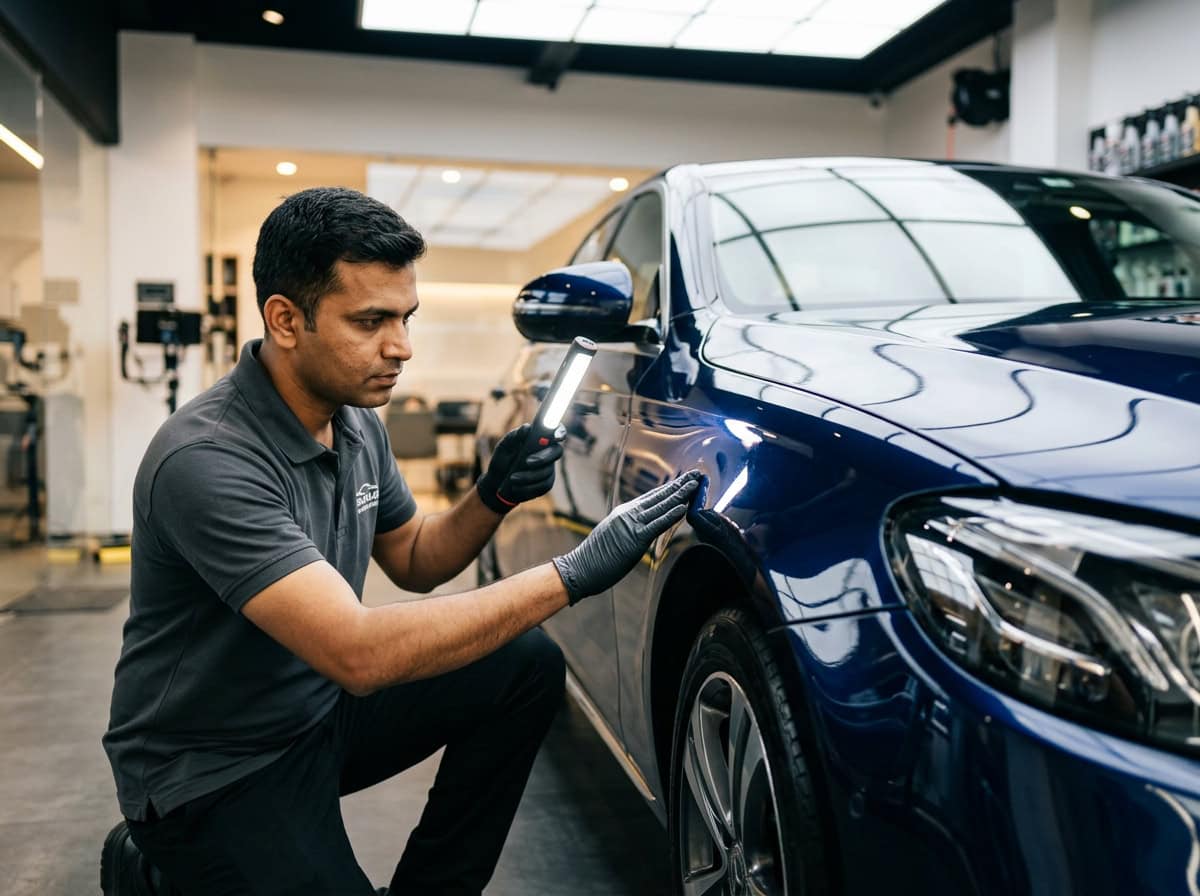
3M notes that rubbing compounds can leave a lustrous shine with minimal swirl marks, but minimal is not the same as none (3M, accessed 2026). By the end of this step, you’ll know how to finish the job properly.
What to do next
- Wipe the panel thoroughly.
- Inspect from multiple angles.
- If needed, follow with a finer polish.
- Apply protection: sealant, wax, or ceramic coating topper.
This matters because rubbing polish corrects defects, but it does not replace protection. If you leave the surface bare, you’ve restored it and then exposed it again.
Verification: The panel should look glossier, cleaner, and more even than before, with protection applied afterward.
Step 6: Know When to Stop and Call a Professional
PPG warns that excessive paint film thickness and refinishing issues can create durability problems, and thin OEM finishes demand caution (PPG, accessed 2026). By the end of this step, you’ll know which defects should not become a DIY ego project.
Stop DIY and get help when
- the scratch is deep enough to catch a nail strongly,
- the defect is through the clear coat,
- the panel edge is involved,
- the paint has already been polished many times,
- you see primer or colour transfer,
- or the panel has unknown repaint history.
Rubbing polish is a correction tool, not a miracle wand. Sometimes the right answer is repaint work, touch-up, or professional paint correction.
Citation capsule: Rubbing polish is ideal for light-to-moderate surface defects, not deep structural paint damage. PPG’s thin OEM paint numbers are the best reminder here: when factory film build is only about 90–120 microns, deep scratches, edges, and unknown repaint sections deserve caution or professional handling rather than aggressive DIY polishing (PPG).
Common Mistakes to Avoid
3M lists defect removal as a serious correction task, which is why rushed use often backfires (3M, accessed 2026). Here are the errors that ruin most DIY jobs.
1. Using rubbing polish as a routine shine product
It is too aggressive for regular use. Use it only when defect removal is actually needed.
2. Working on a dirty panel
Contamination under the pad creates fresh scratches. Always wash and, if needed, clay first.
3. Starting with too much cut
Many owners assume “stronger is better.” It isn’t. Start mild and test first.
4. Overworking edges and ridges
Paint is thinner at edges. That is where beginners cause damage fastest.
5. Skipping protection after polishing
Freshly corrected paint needs wax, sealant, or coating support afterward.
The one mistake that causes the most regret: trying to remove one last faint mark with “just one more pass.” That’s how people turn good enough into expensive.
Results: What Success Looks Like
If the process worked, you should now see clearer reflections, less oxidation, reduced swirl marks, and a more even gloss level. The best result is not “perfect at all costs.” It is clear improvement without unnecessary paint removal.
On a daily driver in India, that is the win you want. A safer 70–80% correction is often better than chasing a risky 100%.
Frequently Asked Questions
What is the difference between rubbing polish and normal polish?
Rubbing polish is more aggressive. It is designed to cut defects like oxidation, water spots, and light scratches, while a normal finishing polish focuses more on gloss refinement. 3M’s defect-removal positioning makes that distinction very clear (3M).
Can I use rubbing polish by hand?
Yes, especially for small areas and light defects. Meguiar’s notes that clear-coat-safe compound can be applied by hand or with a dual-action polisher, which makes hand use practical for spot correction (Meguiar’s, accessed 2026).
Is a car rubbing machine safe for beginners?
A dual-action machine is usually safer than an aggressive rotary because it is more forgiving and less likely to leave severe trails or burn paint. Beginners should still use a test spot first and avoid edges, especially on thin OEM finishes.
Can rubbing polish remove deep scratches?
Usually not. If a scratch catches your nail strongly or has gone through the clear coat, rubbing polish won’t fully remove it safely. At that point, touch-up, wet sanding, repainting, or professional correction may be needed.
How often should I use rubbing polish on my car?
Only when defect correction is necessary. Because OEM paint thickness is limited, repeated abrasive polishing should not become part of a casual monthly routine. Correct sparingly and maintain the finish gently afterward.