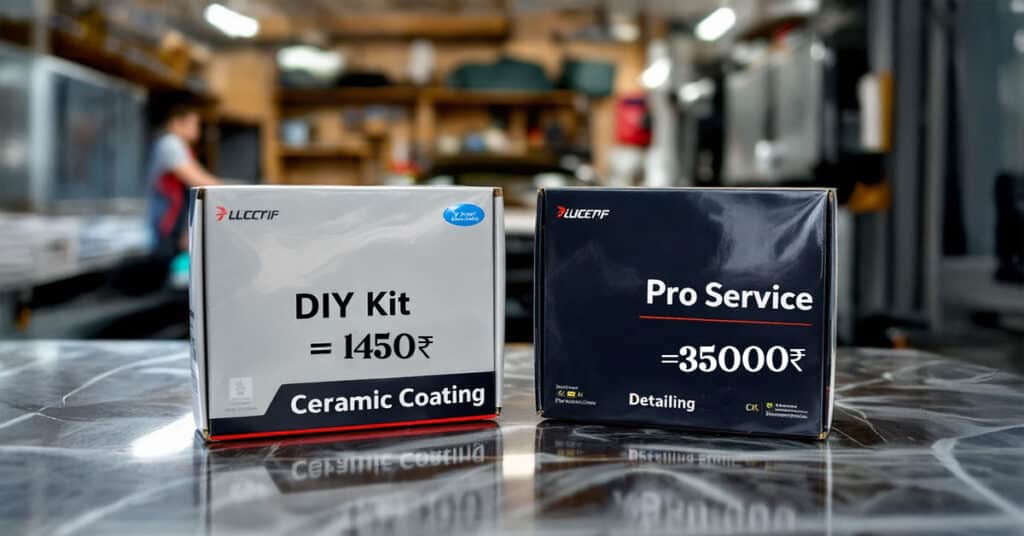

India sold 4.3 million passenger vehicles in FY 2024–25 and the broader car-care products market touched USD 424.92 million in 2024 (SIAM, 2025; IMARC Group, 2025). So yes, more owners are spending on protection. But that still leaves the most important question: is ceramic coating actually worth your money?
Short answer? Yes, for many Indian car owners — but not for everyone.
If you expect ceramic coating to make your car scratch proof, maintenance free, and permanently shiny, it is not worth it. If you want easier cleaning, better gloss, stronger resistance to UV, grime, and daily wear, and you’re willing to wash the car properly, it often is.
This is the no-hype version. No miracle promises. No nonsense.
TL;DR: Ceramic coating is worth it for Indian owners who value easier maintenance, better gloss, and longer-term paint protection, especially with outdoor parking. It is not worth it if you expect zero scratches or never plan to maintain the car. Quality coatings can last 2–10 years depending on prep and aftercare (Gtechniq, 2025).
Verdict Box
Verdict: 8.5 / 10
One-Line Summary: Ceramic coating is worth it for most new or well-kept cars in India, but only when prep quality and aftercare are taken seriously.
Best For: Owners with new cars, dark paints, outdoor parking, premium cars, or people who hate frequent deep cleaning.
Not Ideal For: Owners who use harsh local washes, expect scratch-proof paint, or plan to sell a rough daily driver very soon.
Pricing: Varies by city, car size, correction needs, and product tier. Budget options exist, but prep quality is the real deciding factor.
Key Stat: Gtechniq says quality ceramic coatings can last 2–10 years depending on the product, application, and maintenance (Gtechniq, 2025).
Introduction
India’s climate is not gentle on paint. Heat, dust, monsoon grime, hard water, bird droppings, and open parking all hit the same thin clear coat. PPG places OEM paint thickness at only 90–120 microns total (PPG Refinish, accessed 2026). That means you don’t have much material to abuse.
Ceramic coating is worth it when you want to protect that thin paint system and make your car easier to live with. It is not worth it when you confuse it with paint protection film, or when you pay for a rushed job with poor prep.
The honest shop-floor truth: Most disappointment around ceramic coating comes from bad expectations and bad maintenance, not from the idea of ceramic coating itself.
Pros & Cons Table
| Pros | Cons |
|---|---|
| Easier washing and drying | Not scratch proof |
| Better gloss and slickness | Needs proper maintenance |
| Helps resist UV, grime, and chemical contamination | Cheap packages often skip proper correction |
| Can reduce wash-induced wear when maintained well | Water spots can still happen |
| Strong long-term value on new or well-kept cars | May not make sense for older rough paint |
Testing / Decision Methodology
India’s vehicle parc is growing fast, with 19.6 million two-wheelers and 4.3 million passenger vehicles sold in FY 2024–25 (SIAM, 2025). That scale creates a huge range of buyer types, so a ceramic coating verdict only makes sense when judged by ownership scenario.
In this article, I’m evaluating ceramic coating based on five things that matter in India:
1. outdoor exposure,
2. wash quality,
3. expected ownership period,
4. vehicle condition before coating,
5. and how much the owner values easier maintenance.
If your habits don’t support the coating, the coating won’t rescue you. Brutal, but true.
Why Do Indian Car Owners Consider Ceramic Coating in the First Place?
India’s car-care products market is projected to reach USD 554.42 million by 2033 as buyers spend more on premium cleaning and coating products (IMARC Group, 2025). The direct answer is simple: Indian owners buy ceramic coating because regular paint protection often feels too temporary for Indian conditions.
Wax looks nice, but it fades quickly. Cheap polish can add gloss, but it won’t deliver the same chemical resistance. Ceramic coating sits in that middle ground between routine detailing and expensive paint protection film.
For owners in apartments, office commuters, and highway users, the appeal is obvious:
– the car stays cleaner for longer,
– washing gets easier,
– gloss lasts longer,
– and contamination is easier to remove.
Citation capsule: Ceramic coating appeals to Indian owners because it offers a more durable layer than wax or sealant at a time when buyers are clearly spending more on premium car-care products. IMARC estimates India’s car-care market reached USD 424.92 million in 2024 and will keep growing, driven partly by rising interest in coatings and high-end maintenance products (IMARC Group).
What Does Ceramic Coating Actually Do?
BASF says protective coatings use UV absorbers and stabilisers to defend surfaces from solar radiation, pollutants, humidity, and temperature change (BASF, accessed 2026). That is the right mental model: ceramic coating creates a protective, hydrophobic layer that helps your clear coat deal with daily exposure more gracefully.
What it does well:
– improves gloss and depth,
– makes dirt release easier,
– reduces how stubborn contaminants feel,
– helps with chemical resistance,
– supports easier drying.
What it does not do:
– stop rock chips,
– prevent deep scratches,
– eliminate swirl marks forever,
– remove the need for proper washing.
If you see a seller promising “no scratches ever,” run.
Citation capsule: Ceramic coating is best understood as a sacrificial protective layer that improves gloss, hydrophobicity, and chemical resistance rather than as an armour plate. BASF notes that effective coatings are designed to protect against solar radiation, pollutants, humidity, and temperature changes, which is exactly why ceramic coating is useful in Indian ownership conditions (BASF).
How Long Does Ceramic Coating Last in Real Life?
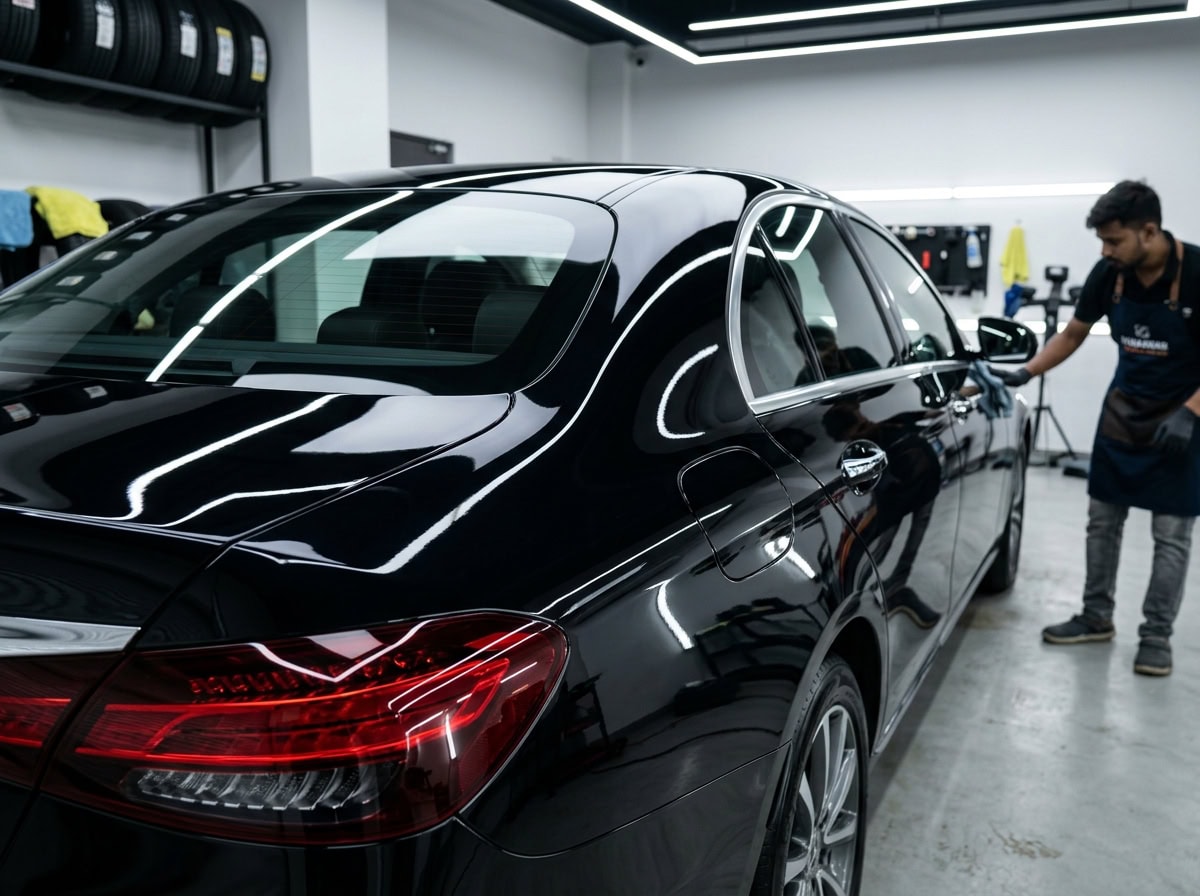
High-quality ceramic coatings usually last 2 to 10 years, according to Gtechniq, but only when applied correctly and maintained properly (Gtechniq, 2025). That’s the honest answer. The salesman’s answer is usually much prettier.
Real-life durability depends on:
– paint condition before coating,
– whether the car was clayed and corrected,
– wash method,
– water quality,
– sun exposure,
– and maintenance toppers.
A car washed weekly with borewell water and wiped with dusty towels will not age like a pampered garage-kept car. Shocking, I know.
Rule worth remembering: Coating lifespan is often decided after installation, not on installation day.
Citation capsule: Ceramic coating longevity is not a fixed number. Gtechniq places the real-world range at 2–10 years and says product quality, correct application, and aftercare are the main variables. For Indian owners, that means the same coating can feel brilliant on one car and disappointing on another depending on wash habits and parking conditions (Gtechniq).
When Is Ceramic Coating Worth the Money?
PPG says factory paint is only 90–120 microns thick overall, which means every polishing cycle eats into a limited paint system (PPG, accessed 2026). Ceramic coating is worth the money when it helps you preserve that finish and reduce how often aggressive correction is needed.
It’s usually worth it if:
– your car is new or nearly new,
– you own a dark shade that shows every mark,
– the car is parked outdoors daily,
– you plan to keep it for 3+ years,
– you care about appearance and resale impression,
– or you already spend time maintaining the car properly.
For luxury cars and enthusiast-owned cars, the answer is even more likely to be yes because finish preservation matters more.
Citation capsule: Ceramic coating becomes financially sensible when it helps preserve a thin factory paint system and lowers the need for frequent aggressive polishing. Since PPG places OEM paint thickness at roughly 90–120 microns, preserving the clear coat matters, especially for owners planning to keep their cars longer or who park outside every day (PPG).
When Is Ceramic Coating Not Worth It?
3M lists oxidation, water spots, stains, and sanding scratches among the defects that need correction compounds to remove them (3M, accessed 2026). That points to the uncomfortable truth: coating cannot hide badly damaged paint.
Ceramic coating may not be worth it if:
– the paint is already very rough and you won’t pay for correction,
– you rely on harsh roadside washing,
– the car is due for repaint work,
– you want maximum impact protection, in which case PPF is the better category,
– or you plan to sell the car very soon and won’t benefit from the long-term value.
It also may not be worth it on a very old daily driver if your priority is simply “good enough, cheap, and easy.” In that case, a quality polish-and-sealant routine might be the smarter choice.
The biggest mismatch: Owners who spend on coating but still use dirty cloths, detergent-based washes, and zero drying discipline. That’s like buying expensive sneakers and then walking through wet cement.
Citation capsule: Ceramic coating is a poor fit when the paint is already damaged, the wash routine is abusive, or the owner really needs impact protection instead of easier maintenance. 3M’s defect-removal guidance underlines the point: oxidation, stains, and water spots still require correction, which means coating cannot replace proper paint restoration (3M).
Is It Better Than Wax, Sealant, or “Crystal Coating” Packages?
India’s market for premium car-care products is growing because more owners are moving beyond basic waxes and cleaners (IMARC Group, 2025). For most buyers, ceramic coating is worth more than wax because it lasts longer and needs less frequent reapplication.
Sealants can still be excellent for budget-conscious owners. A good sealant is easier and cheaper to refresh. But it usually won’t match the longevity or chemical resistance of a properly installed ceramic coating.
As for “crystal coating,” treat the term carefully. Sometimes it refers to a genuine ceramic-style coating. Sometimes it is just a marketing label. Ask what chemistry is used, what correction is included, what maintenance is required, and what warranty terms actually mean.
Alternatives
Paint Protection Film (PPF)
Best if you need: Stone-chip and impact protection.
Price: Usually higher than ceramic coating.
Key difference: Better for physical protection, not just gloss and wash ease.
Quality Sealant
Best if you need: Lower cost and easy DIY upkeep.
Price: Lower.
Key difference: Shorter life, but good value for budget-minded owners.
Routine Polish + Wax
Best if you need: Presentable shine on an older car.
Price: Lowest.
Key difference: Great for cosmetic refresh, weaker for long-term protection.
Final Verdict
So, is ceramic coating worth it? Yes — for the right owner, absolutely. India’s climate, pollution, and wash realities make easier maintenance and paint preservation genuinely valuable.
But it is only worth it when:
1. the prep is done properly,
2. the coating matches the car’s condition,
3. and the owner maintains it like an adult.
If you want the cleanest answer:
– Worth it: new cars, premium cars, dark colours, outdoor parking, appearance-conscious owners.
– Not worth it: neglected paint, rough wash habits, short ownership, unrealistic expectations.
Would I choose it on a new car I plan to keep? Yes. Without hesitation.
Frequently Asked Questions
Is ceramic coating worth it on a brand-new car?
Usually yes. New paint gives the installer a better starting point, so you preserve the finish earlier and reduce long-term wear. Since PPG puts OEM paint thickness at only 90–120 microns, protecting fresh factory paint early can make more sense than repeatedly correcting it later (PPG).
Does ceramic coating remove scratches?
No. It protects; it does not erase damage. 3M specifically positions rubbing compounds for removing water spots, oxidation, stains, and sanding scratches, which shows that defects still need correction before or after protection when necessary (3M).
Is ceramic coating better than waxing in India?
For long-term ownership, yes. Wax is cheaper and faster, but ceramic coating usually lasts much longer and offers stronger day-to-day ease of cleaning. In Indian heat, dust, and monsoon grime, that maintenance advantage can be worth a lot.
How long does ceramic coating last in India?
A good coating can last years, but the range varies. Gtechniq says 2–10 years is typical depending on product quality, prep, and aftercare (Gtechniq, 2025). Outdoor parking and hard-water washing will shorten that experience if you neglect maintenance.
Is ceramic coating worth it for an old car?
Sometimes, but not always. If the paint can be corrected well and you plan to keep the car, it may still make sense. If the paint is already weak or you only want a budget refresh, a polish-plus-sealant plan may be smarter.