
India’s car-care products market reached USD 424.92 million in 2024 and is forecast to grow at 3.00% CAGR from 2025 to 2033, according to IMARC Group. That means more Indian owners are finally looking beyond simple wash-and-wipe care and asking a smarter question: which wax actually suits our heat, dust, rain, and hard-water reality?
This guide is built for that question. Not every Indian car needs the same wax. A black Creta parked outside in Kochi, a white Swift kept in a covered apartment lot in Bengaluru, and a weekend bike in Coimbatore should not all be buying by hype.
TL;DR: If your car is a daily driver parked outdoors, synthetic wax is usually the safer pick because it handles heat, UV, detergents, and rain better. If your car is pampered, darker in colour, or weekend-driven, carnauba still wins on warmth and depth. IMARC says India’s car-care market hit USD 424.92M in 2024, so there’s no reason to buy blindly now.
What is carnauba wax, and why do detailers still love it?
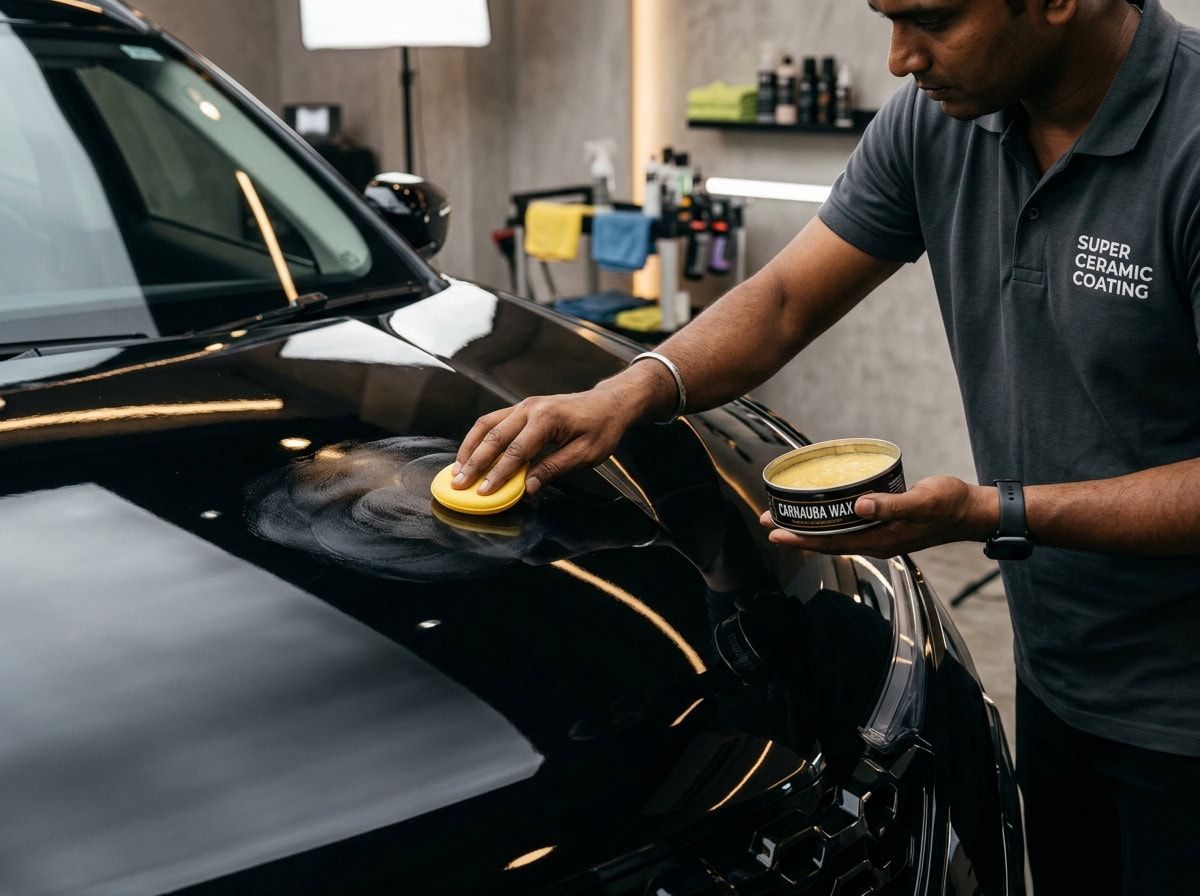
Chemical Guys explains that carnauba wax comes from the Brazilian carnauba palm and is prized for its deep, warm gloss, especially on darker paint shades (Chemical Guys, 2025). That’s the short answer: carnauba is popular because it makes paint look richer.
Carnauba wax is a natural wax blended with oils and other ingredients so it can be spread on paint. It’s not chosen because it lasts forever. It’s chosen because it gives paint a softer, wetter, more premium-looking glow than many synthetic products.
On black, blue, maroon, and deep grey cars, that look can be lovely. If you’re the type who enjoys Sunday detailing, carnauba feels rewarding. You apply it, buff it, and the car looks fuller and more elegant.
Citation capsule: Carnauba wax remains relevant because it gives paint a warmer, deeper appearance than most synthetic products. Chemical Guys’ 2025 explainer notes that true carnauba comes from the Brazilian palm and is still preferred by enthusiasts who care more about visual richness than maximum durability.
Why does synthetic wax suit more Indian daily drivers?
Surf City Garage says synthetic sealants and waxes offer higher resistance to heat, UV rays, and detergent abuse than natural waxes, which makes them ideal for vehicles kept outside and used daily (Surf City Garage, accessed 2026). For India, that’s the deciding factor more often than people admit.
A daily driver in India faces sun, dust, rain, traffic film, poor parking shade, and frequent washing. That environment punishes short-lived products. Synthetic wax or polymer-based protection usually lasts longer and asks for less frequent reapplication.
Road & Track’s 2025 wax testing also leaned toward durable, easy-to-use waxes for daily use, noting that products exposed to real-world conditions need to balance gloss with longevity (Road & Track, 2025).
If your car lives outdoors at work and at home, synthetic is usually the better default. It’s less romantic. It’s also more realistic.
Citation capsule: Synthetic wax is the safer all-round choice for most Indian daily drivers. Surf City Garage says synthetic protection resists heat, UV, and detergent abuse better than natural wax, while Road & Track’s 2025 testing favoured products that paired gloss with durable real-world performance.
In Indian cities, wash frequency often matters more than brochure durability. A wax that looks stunning but collapses after repeated local wash routines is rarely the best buy.
Which wax type should you buy for your colour, budget, and parking situation?
IMARC says Indian buyers are spending more on premium waxes and coatings as awareness rises (IMARC Group, 2026). That’s useful context, but choosing well still comes down to use case.
Quick decision rules
- Choose carnauba wax if: you love a warm shine, own a dark-coloured car, enjoy frequent detailing, and keep the vehicle mostly covered.
- Choose synthetic wax if: your car is a daily driver, parked outside often, washed regularly, or exposed to strong sun and monsoon grime.
- Choose hybrid products if: you want some of the look of carnauba with better durability than traditional wax.
Best fit by owner profile
1. Best wax type for dark-coloured show-like finish: Carnauba wax
Chemical Guys says carnauba delivers a natural, deep gloss and enhances darker shades especially well (Chemical Guys, 2025). That makes it a strong pick for black and dark-blue cars when looks matter most.
Examples you’ll commonly see in the market include classic paste or liquid waxes and carnauba-rich blends such as Meguiar’s Gold Class Carnauba Plus-style products or Turtle Wax carnauba-based options. You’re buying visual richness first.
Best for: covered parking, weekend cars, enthusiasts, dark paint.
2. Best wax type for daily-driver protection: Synthetic wax
Surf City Garage says synthetic protection provides more durability than comparably priced wax products and is better suited to full-time outdoor use (Surf City Garage, accessed 2026). That is exactly what most Indian hatchbacks and SUVs need.
Examples include polymer-heavy liquid waxes, synthetic paste waxes, and easy spray waxes intended for fast upkeep.
Best for: office commuters, apartment parking, outdoor exposure, white/silver cars, busy owners.
3. Best wax type for easy maintenance: Spray wax or hybrid wax
Road & Track’s 2025 test praised easy-to-use spray products that can act as a quick gloss booster with respectable beading (Road & Track, 2025). These are ideal when you want speed over ritual.
Some Turtle Wax India listings also highlight synthetic polymers, hydrophobic behaviour, and even carnauba-infused spray formats for fast application (Turtle Wax India, accessed 2026).
Best for: new car owners, bike owners, frequent top-ups, low-effort maintenance.
Comparison table: Carnauba vs synthetic wax in India
IMARC says India’s car-care market reached USD 424.92 million in 2024, and that rising spend is exactly why buyers should compare wax categories before purchasing (IMARC Group, 2026). Road & Track, Chemical Guys, and Surf City Garage together make the trade-off clear: buy carnauba for richer looks, synthetic for tougher real-world use.
| Category | Carnauba Wax | Synthetic Wax |
|---|---|---|
| Best for | Warm, rich show-like gloss | Daily-driver protection |
| Look | Deep, wet, warm | Bright, crisp, reflective |
| Durability | Lower | Higher |
| Heat tolerance | Lower | Better |
| Outdoor parking | Okay with reapplication | Better choice |
| Dark colours | Excellent | Good |
| White/silver cars | Good | Often excellent |
| Maintenance effort | Higher | Lower |
| Beginner friendliness | Moderate | Often easier in liquid/spray forms |
| Our verdict | Buy for looks | Buy for real-world use |
Citation capsule: Carnauba and synthetic wax are not direct replacements for every owner. Chemical Guys positions carnauba as the deeper-looking option, while Surf City Garage highlights synthetic protection as better against heat, UV, and detergents, making synthetic the better default for most Indian outdoor-parked cars.
How should you actually buy the best car wax in India in 2026?
IMARC reports rising demand for premium car-care products in India, but “premium” doesn’t automatically mean “right for you” (IMARC Group, 2026). The best buy is the wax you will actually apply and maintain properly.
Use this checklist:
- Check your parking reality. Outdoor? Go synthetic.
- Check your paint colour. Dark car and weekend use? Carnauba becomes more attractive.
- Check your wash habits. Frequent local washes favour tougher products.
- Check effort tolerance. Love detailing? Paste/liquid carnauba is fine. Hate effort? Hybrid spray.
- Check product type honestly. A “wax” may be hybrid, synthetic-heavy, or a gloss topper. Read the label.
What about bikes?
Bike owners should usually lean toward easy-maintenance products. Smaller panels make application simpler, but exposure is often harsher. A simple synthetic spray wax or sealant-style product is usually more practical than a traditional enthusiast paste wax.
For Indian owners who wash at home on weekends, the winner is often not the “best” wax on paper. It’s the one that goes on quickly, wipes off cleanly, and doesn’t punish you for missing one maintenance cycle.
Frequently Asked Questions
What is carnauba wax for a car?
Carnauba wax is a natural wax sourced from the Brazilian carnauba palm. Chemical Guys says it’s valued for a deep, warm gloss and is especially flattering on darker paint colours (Chemical Guys, 2025).
Is synthetic wax better than carnauba wax in India?
For most daily drivers, yes. Surf City Garage says synthetic protection offers better resistance to heat, UV, and detergent abuse, which fits India’s outdoor parking and regular washing patterns better than traditional wax (Surf City Garage).
Which is the best car wax for black cars in India?
If your black car is well-maintained and covered, carnauba is hard to beat for visual warmth. Chemical Guys specifically highlights carnauba’s depth on darker shades, while synthetic wax remains the better practical choice for black cars parked outdoors daily (Chemical Guys, 2025).
How long does car wax last in Indian weather?
It depends on product type, washing, and parking. Adams Polishes notes that wax is more vulnerable to heat, detergents, and abrasion, while synthetic protection is built for better durability (Adams Polishes, accessed 2026). Hot outdoor parking shortens wax life quickly.
Should I buy wax, sealant, or ceramic coating?
Start with your ownership style. Wax is great for looks, sealant-style synthetic products suit daily use, and ceramic coating is best when you want stronger long-term protection. IMARC’s data on India’s growing premium car-care market shows more owners are moving up that ladder as awareness improves (IMARC Group).
Conclusion with top pick recommendation
For most Indian owners, synthetic wax is the best car wax category to buy in 2026 because it better matches heat, UV, rain, dust, and frequent washing. Carnauba is still beautiful. It just isn’t the most practical choice for every daily driver.
Choose synthetic if you want easier ownership. Choose carnauba if you care most about that rich, freshly detailed glow. Want both? A good hybrid product is the middle path.